
The Power Price at Which 180 TH/s Stops Making Sense
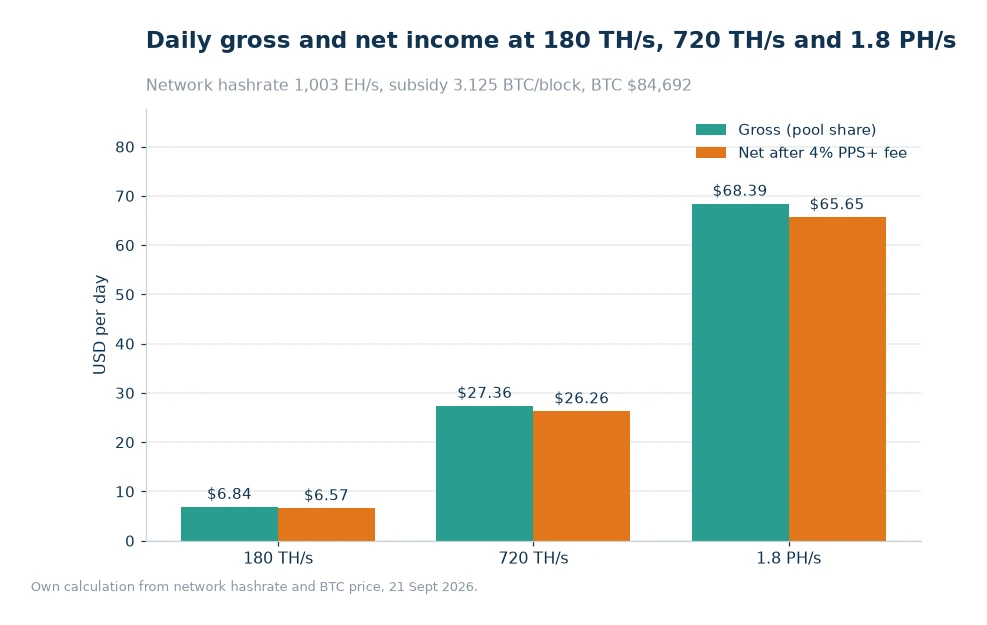
Mining economics are usually presented as an income figure when they are really a ceiling on cost. At 180 TH/s the rig nets 6.57 USD a day after the listed fee, and at 20 J/TH it burns 86.4 kWh in the same period. Divide one by the other and the break-even power price is 7.6 cents per kilowatt-hour — above that, the machine is working for the utility.
Key takeaways
- 180 TH/s nets 6.57 USD a day and consumes 86.4 kWh at 20 J/TH, a ceiling of 7.6 cents per kWh.
- A less efficient 25 J/TH unit at the same hashrate drops the ceiling to 6.1 cents.
- Scaling to 1.8 PH/s multiplies both income and consumption, leaving the ceiling unchanged.
- Put the ceiling on the invoice, not in a spreadsheet nobody opens at month end.
Gross output is not the number an accountant needs
An accountant wants two columns: revenue and cost. Mining dashboards happily provide the first and stay silent on the second. The gap between a gross figure and a net one at 180 TH/s is 27 cents a day, which is 8.10 USD a month — small beside a power bill, and easy to leave out of a comparison between two sites with different tariffs.
The number that actually decides whether a site works is the highest power price at which the machine still covers its own electricity. That is a single figure, it does not move with the size of the operation, and it can be compared directly with a tariff. Once you have it, a power contract becomes a yes-or-no question rather than a negotiation conducted in the dark.
From daily coins to a cost per kilowatt-hour
Three steps get there. Convert the hashrate into daily BTC using the network figure. Convert the BTC into dollars at the price you can see. Convert the watts into kilowatt-hours and divide the dollar figure by it. The result is a ceiling: pay less and the machine has a margin, pay more and it does not.
The calculation assumes the machine runs flat out, which is the friendly assumption. A unit that throttles in warm weather produces less while drawing nearly the same power, so the real ceiling is a little lower than the arithmetic suggests. Treat the number from the formula as a best case and leave a cent of headroom for the summer.
Meter the room rather than trusting the label. A plug-in meter on one machine will show a draw a few percent above the rated figure, because the power supply converts with a loss and the fans are not in the rating. Multiply that measured draw by the number of machines and the ceiling falls by the same few percent, which is often enough to change the answer at the margin.
Three tiers and the ceiling each one carries
The table holds efficiency at 20 J/TH for the first three rows and then tests a less efficient unit, which is the variable most often skipped in a purchase decision.
| Configuration | kWh per day | Net per day | Break-even per kWh |
|---|---|---|---|
| 180 TH/s at 20 J/TH | 86.4 | $6.57 | $0.076 |
| 720 TH/s at 20 J/TH | 345.6 | $26.26 | $0.076 |
| 1.8 PH/s at 20 J/TH | 864.0 | $65.65 | $0.076 |
| 180 TH/s at 25 J/TH | 108.0 | $6.57 | $0.061 |
The first three rows share a ceiling because both sides of the ratio scale together. The fourth row is the interesting one: same hashrate, same income, five cents an hour more per machine, and the ceiling collapses by a sixth. Efficiency is not a spec-sheet vanity metric; it is the width of the range of power contracts you can accept.
Worked example
Build the 180 TH/s ceiling from the chain inputs, then test a tariff against it.
- Daily issuance per terahash: 450 ÷ 1,003,000,000 = 0.00000044865 BTC.
- 180 TH/s claims 0.00008075 BTC of that total.
- At 84,692 dollars, the gross is 6.84.
- Ninety-six percent of it survives the 4% block-reward charge: 6.57.
- Power: 180 × 20 J = 3,600 W = 3.6 kW; 3.6 × 24 = 86.4 kWh a day.
- Ceiling: 6.57 ÷ 86.4 = $0.0760 per kWh.
- At $0.09 per kWh the daily cost is 86.4 × 0.09 = $7.78, which exceeds the $6.57 income by $1.21 a day, or about $36 a month.
What a 2.12% cut does to the ceiling
If the estimated downward difficulty adjustment holds, output per terahash rises by about 2.17%, and the ceiling rises with it. At 180 TH/s the daily net becomes roughly 6.71 USD and the ceiling moves to 7.8 cents. A rise of the same size moves it back to 7.4 cents. The ceiling is therefore a moving number, and the right time to lock a power contract is when the margin between the tariff and the ceiling is wide enough to absorb a few adjustments in the wrong direction.
Two cents of headroom is a reasonable target. It covers a few difficulty rises, a warm month that forces throttling, and the ordinary drift of a machine that is no longer new. A site signed at exactly the ceiling has no room for any of those, which is why the arithmetic should be run before the contract rather than after the first invoice arrives in the post.
Keeping the fee and the power cost apart in the books
Both reduce what reaches the bank and they behave differently. The pool's listed 4% scales with output and disappears if the machine is off; the power bill scales with hours and keeps arriving during a repair. A bookkeeping habit that lumps them into one "costs" line hides which one is eating the margin in a bad month.
Keep three lines: gross output, pool fee, power. The pool fee should be about 4% of gross on the block-reward stream and 2% on the transaction-fee stream; if it is not, the statement is worth reading more closely. Power should be the tariff multiplied by metered kilowatt-hours, not by the rated wattage, because fans and conversion losses are part of the load. The fee schedule gives the first numbers and the utility gives the second.
The ViaBTC Bitcoin Mining dashboard reports the two income streams separately, which is what makes the fee line checkable instead of assumed. Pull the statement once a month, put the three lines in a spreadsheet beside the tariff, and the ceiling recalculates itself without another round of arithmetic.
Frequently asked questions
What power price makes 180 TH/s unprofitable?
Any tariff above about 7.6 cents per kilowatt-hour at 20 J/TH, since the machine nets 6.57 USD a day and consumes 86.4 kWh over the same period.
Does a bigger operation get a better break-even price?
No. At the same efficiency, 720 TH/s and 1.8 PH/s have the same 7.6-cent ceiling because income and consumption scale together; only efficiency or the coin price moves it.
How much headroom should I leave above the ceiling?
About two cents per kilowatt-hour, which absorbs a few difficulty increases, a warm month of throttling and the normal decline of an ageing machine.
Write the ceiling beside the invoice
Put the number on the same sheet as the tariff. If the tariff is below the ceiling by a margin you would still accept after two difficulty rises, the site is sound. If it is above, no amount of dashboard tuning changes the outcome, and the honest options are cheaper power, newer hardware or fewer machines, in that order. The Profit Calculator will produce the income side at the hashrate you are considering, and the utility bill will supply the other half of the comparison.
Sources: ViaBTC home, fee and calculator pages for output estimates and the 4%/2% split[1]. Readings taken 21 Sept 2026: 1,003 EH/s, 132.76 T difficulty, 3.125 BTC per block, 144 blocks a day, $84,692 per BTC, next adjustment estimated −2.12%. Source figures read 21 Sept 2026, published 24 Oct 2026. Ceilings exclude cooling power and assume flat-out running.