
§ Materials, Packaging & Textiles
Evaluating OEM/ODM Suppliers for a Festive Gifting Range: A Buyer's Checklist
A gifting range is the least forgiving project a fragrance supplier will run for you. The date cannot move, the packaging carries most of the perceived value, the volumes are uneven and the assortment has to look like a set rather than a collection of leftovers. Evaluating an OEM/ODM partner for this kind of work therefore means testing calendar discipline and kitting capability at least as hard as you test the scent. The checklist below is ordered by what breaks first.
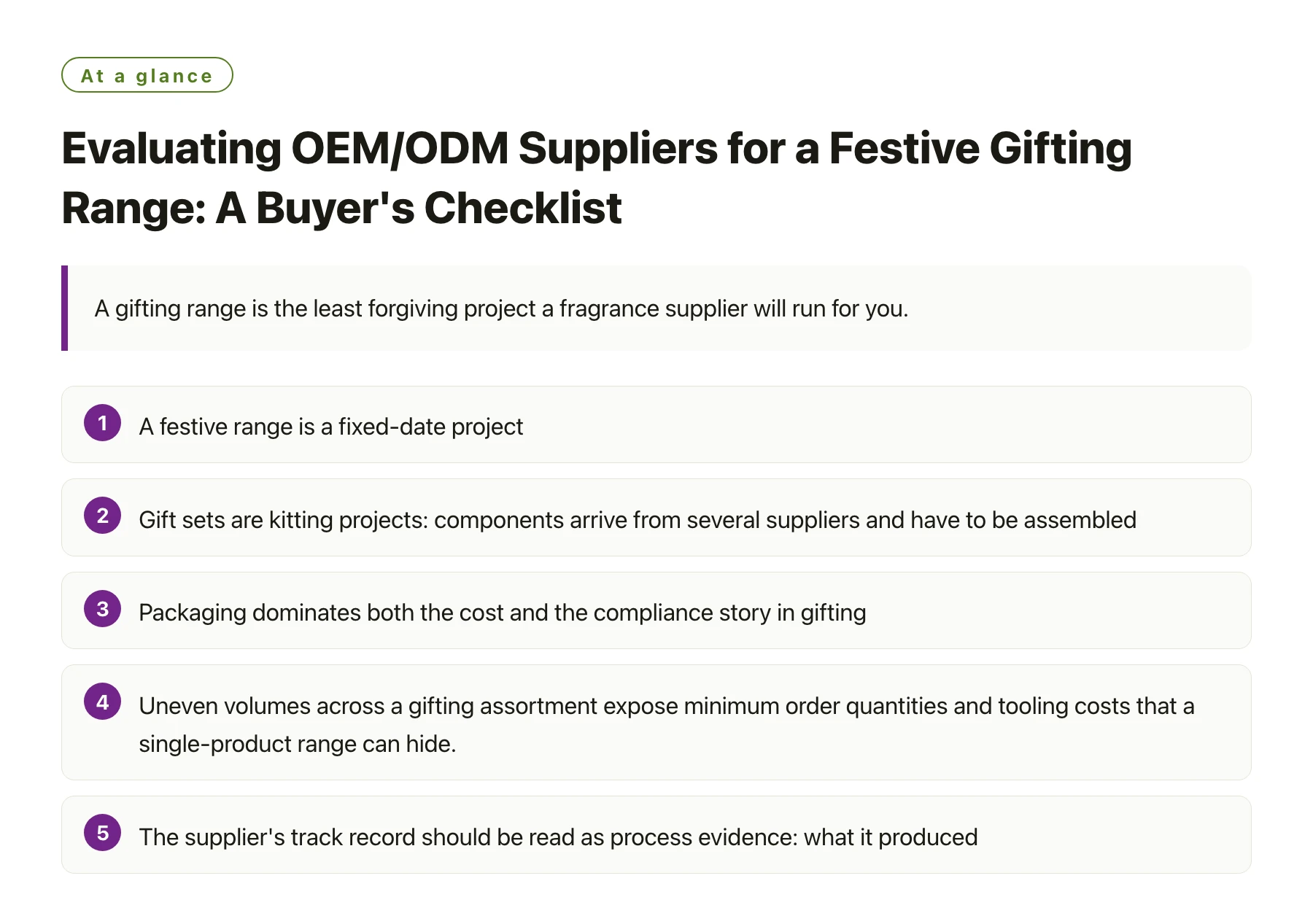
Key takeawaysA festive range is a fixed-date project, so the supplier's ability to work backwards from a ship date matters more than its best-case lead time. · Gift sets are kitting projects: components arrive from several suppliers and have to be assembled, checked and packed as one unit. · Packaging dominates both the cost and the compliance story in gifting, so the supplier's packaging knowledge should be evaluated as a core capability. · Uneven volumes across a gifting assortment expose minimum order quantities and tooling costs that a single-product range can hide. · The supplier's track record should be read as process evidence: what it produced, in what sequence, with what documentation.
Fragrance gift sets look simple from the outside: a box, a bottle and a bow. Operationally they are among the most demanding orders in the category, because they combine a manufactured liquid with purchased components, presentation packaging, assembly labour and a deadline that is set by a retail calendar rather than by production. A supplier that is excellent at bulk fragrance filling may still be the wrong partner for a coffret.
This checklist is written for the person buying a festive gifting range, usually a category or seasonal buyer at a retailer or a founder building a holiday launch. It sets out what to evaluate, what to ask for as evidence, and where gifting programmes most often fail.
Why a gifting range tests a supplier differently
The first difference is the deadline. A spring launch can slip three weeks and remain a spring launch; a festive assortment that slips three weeks may miss its entire selling window. That makes the supplier's scheduling discipline a commercial issue rather than an administrative one, and it makes the ability to work backwards from a ship date the single most valuable thing to verify.
The second difference is assembly. A gift set brings together fragrance, bottle, closure, outer box, insert and any accessory, and those items typically come from different suppliers with different lead times. The partner acting as fragrance OEM/ODM production partner has to coordinate that assembly, because the alternative is that you do it, in a warehouse, in December.
The third difference is presentation. In gifting, the packaging is not a container for the product; it is a large part of what the customer is paying for. Print quality, colour consistency across a set, insert fit and the way a box opens all sit inside the product quality definition, and they deserve to be evaluated on the same level as the fragrance.
Evaluation areas for a gifting supplier
| Evaluation area | What good looks like | Evidence to keep on file |
|---|---|---|
| Calendar discipline | A written schedule that works backwards from the retail ship date with your own inputs marked on it | The schedule itself, with named owners and dates for artwork, components and approvals |
| Kitting and assembly | A described assembly process, with component checking and a reject rule for damaged or mismatched items | Assembly instructions, in-process check records and a pack-out specification |
| Packaging capability | Advice on structure, materials and print that arrives before the artwork is frozen | A packaging specification, print proofs and the tolerance agreed for colour and fit |
| Compliance of the pack | Awareness of packaging and labelling obligations in the destination markets | A document list per market, and the material and labelling data behind it |
| Volume flexibility | Clear minimums per component and an honest statement of where extra volume can and cannot be absorbed | Component minimums and tooling costs quoted as separate lines |
| Sampling for gifting | A sample that represents the finished set, not only the liquid | A physical pre-production sample of the assembled gift unit, signed and dated |
| Documentation at handover | A defined document pack that travels with the shipment | The agreed list: specification, batch record extract, safety and labelling data, packing list |
Score each row explicitly. A supplier that is strong on fragrance and weak on assembly is not a bad factory; it is the wrong factory for a gifting range, and it may still be the right one for a core line.
The packaging questions most buyers ask too late
Packaging drives both cost and risk in a festive order, and the rules around it are tightening in several markets. Extended producer responsibility and packaging waste regulation in the European Union, for example, now shape what a brand can put on a shelf and what it must report, and that has a direct effect on gift packaging design [1]. Suppliers who follow this area can tell you early which structures will create avoidable obligations later.
Sustainability in packaging is not a single standard but a field of competing design choices, and industry coalitions publish guidance on how to weigh recyclability, material reduction and reuse [2]. For a gifting range the practical consequence is simple: if you want a recyclable structure, decide it before the die is cut, because retrofitting a box is a tooling project, not an artwork change.
The fragrance side has its own constraints, and they do not relax because the product is a gift. Materials used in a seasonal set are subject to the same usage restrictions as those in a core line, and a formula built for a one-off run still has to be documented [3]. Buyers sometimes treat gifting as a lower-stakes experiment; the compliance desk does not.
There is also a purely commercial trap. Gifting programmes often include a premium tier, and buyers assume that high-end perfume production is mainly a matter of better materials. In practice the visible difference is usually in consistency, decoration and pack finish, which are process capabilities rather than ingredients, and they are the ones worth checking with a sample set in your hands.
Understand how a wholesale gifting order is costed
Gifting quotations hide more structure than standard product quotes, because development, filling, decoration, components, assembly and freight all behave differently with volume. Knowing how wholesale custom fragrance projects work gives you a structure to ask for, and it turns a single intimidating number into lines you can negotiate or remove.
The common surprise is assembly labour, which scales with the complexity of the set rather than with the volume of fragrance. A two-piece set with a printed sleeve is a different cost object from a five-piece set with a fitted insert, even when the total liquid volume is identical.
Reading a track record rather than a capability list
Capability lists describe what a factory can do in principle. A track record shows what it has actually shipped, and for gifting it is worth asking for the specific case: what the set contained, how the components were sourced, how the packaging was approved and what the run looked like at packing. Looking at brands Xuelei has manufactured for — or any supplier's published case material — is useful mainly for the process detail it exposes, not for the names.
Ask about the failures too. A supplier that can describe a gifting run where a component arrived late, and explain what it changed afterwards, is telling you more than one that reports only smooth projects. The question is not whether a factory has had problems; it is whether it has a routine for noticing and fixing them.
Finally, match the evaluation to the value at risk. A small first gifting range can be run with a stock box and a stock bottle, which reduces tooling cost and calendar risk; the second season, with real sales data, is a better moment for bespoke structures. Suppliers who push bespoke packaging into a first range are optimizing their order value rather than your launch.
Build the gifting calendar backwards and put the riskiest item first. In most festive projects that item is the printed or bespoke component, not the fragrance. If the packaging timeline has no float, no amount of factory goodwill will recover the ship date, so treat the float as a deliverable you negotiate for.
Sources
- European Commission: Packaging Waste and the PPWR —— EU rules on packaging and packaging waste, including the Packaging and Packaging Waste Regulation requirements on recyclability and design.
- Sustainable Packaging Coalition —— A membership organisation working on more sustainable packaging design, publishing material and recyclability guidance.
- IFRA Standards Library (International Fragrance Association) —— The IFRA Standards Library lists the restrictions the fragrance industry applies to individual fragrance ingredients, based on safety assessments; it is the reference point for compliant fragrance formulation.
Frequently asked questions
What is the biggest risk in a festive fragrance range?
The calendar. Festive selling windows are short and fixed, and a late packaging component or a postponed approval can push a range past its season entirely, which is worse than a delayed spring launch.
Should a first gifting range use bespoke packaging?
Usually not. Stock bottles, boxes and inserts reduce tooling cost and calendar risk, and they let you learn what sells before committing to bespoke structures in the second season.
How do gift sets differ from standard fragrance orders?
They are kitting projects as much as manufacturing projects: multiple components from different suppliers are assembled, checked and packed as one unit, and assembly labour scales with set complexity.
What sample should we ask for before approving a gift set?
A physical pre-production sample of the assembled set, including the box and insert, signed and dated by both sides. A liquid sample alone does not represent a gifting product.
Does packaging regulation affect gift boxes?
It can, particularly in markets with extended producer responsibility or packaging waste rules. Those obligations are best raised at the design stage, before tooling, because changing a structure later is expensive.
From reading to running line by Friday.
Book a 60-minute on-site discovery visit with a Rowi solutions engineer. We audit, we quantify, we leave you with a plan — even if the plan isn't with us.