
Custom Jewelry Manufacturer Vetting: Six Documents to Request
Vetting a manufacturer is a paperwork exercise before it is a factory visit. Six documents cover almost everything a brand needs to know: a quality certificate, a social audit report, a materials statement, a process description, an ownership agreement and a packaging specification. The published figures that go with them — 50 pcs minimum in 925 sterling silver and a 25–30 day sampling window — are the ones a document can confirm.

Key takeaways
- Three compliance documents: the ISO 9001:2015 certificate, the BSCI audit report and the REACH materials statement covering lead, cadmium and nickel.
- Three commercial documents: the process description, the design-ownership terms and the packaging specification.
- Every claim has a figure attached: CAD CAD 48 hours, sample 25–30 days, run 3–4 weeks — CAD, sample, run (run) — CAD, sample, run for the run for production, 100% inspection.
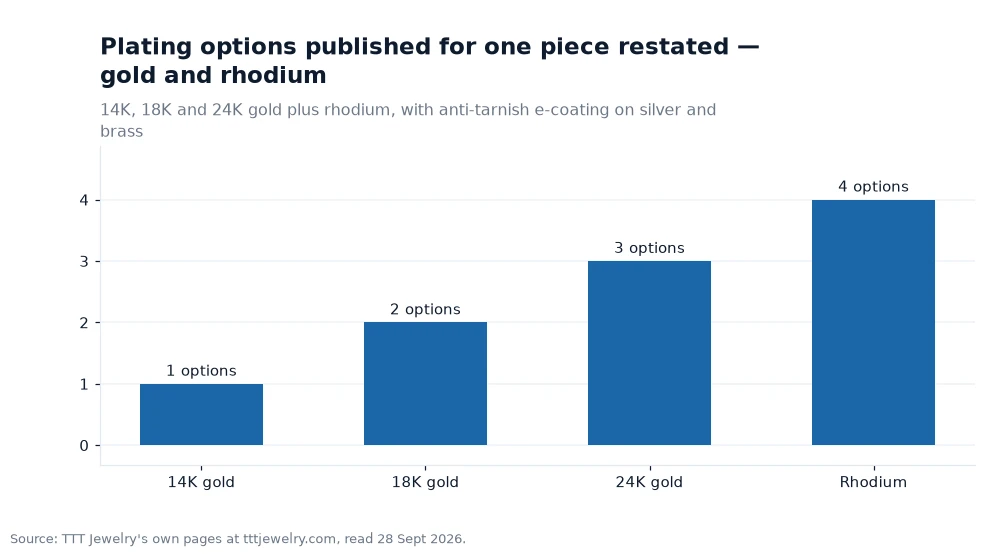
- 14K/18K/24K gold and and rhodium, then an anti-tarnish e-coat for silver and brass and PVD on stainless steel for durability.
Why documents beat a factory tour
A tour is a photograph taken from inside. Documents are the record that survives the visit, and they are the only way to compare two suppliers on the same terms. Six documents, requested in one message, sort a shortlist faster than any amount of email negotiation.
Each of the six answers a different question, and none of them is a substitute for another. That is the reason the list is six long rather than one long. There is also a forwarding argument: a retail partner, a fulfilment team or an insurer can read the same six pages without another meeting, and a claim that survives being forwarded is usually a claim that has already been checked.
Documents one to three: compliance
The first is the ISO 9001:2015 certificate, which describes a quality management system applied across all production stages. The second is the BSCI audit report, covering workplace safety, fair labour practices and a traceable, ethical supply chain. The third is the materials statement behind REACH compliance: metals free from lead, cadmium and nickel, with the plating declared compliant with REACH and California Proposition 65.
Read the dates and the scope on each one. A certificate issued to a different legal entity, or one older than the current workshop, describes a company that is not the one quoting you.
Documents four to six: process, ownership, packing
The fourth document is the process description, and it should name operations rather than outcomes: concept and CAD design → the prototype stage → sprue cutting to release the casting → gloss polishing → surface art → electroplating → final QC → delivery to the brand, wrapped inside the six customer stages from enquiry to shipment. The fifth is the ownership terms, where the published position is 100% NDA with moulds, CAD files and collections kept exclusive to the buyer's brand. The sixth is the packaging specification, listing the formats and the labelling standard.
| Document | What it proves | Figure to check against it |
|---|---|---|
| ISO 9001:2015 certificate | Documented, repeatable process | Applied across all production stages |
| BSCI audit report | Labour and supply-chain conduct | Audit date and scope |
| REACH materials statement | Restricted substances declared | Lead, cadmium, nickel |
| Process description | Operations are named and sequenced | 8 factory steps, 6 customer stages |
| Ownership terms | Designs stay with the buyer | 100% NDA |
Vetting the plating claim, which is the most detailed
Finishing is the easiest claim to overstate and the easiest to verify, because it is itemised. Electroplating is multi-layer precious metal: 14K gold, 18K gold, 24K gold or rhodium. Silver and brass then take a protective anti-tarnish e-coating, while stainless steel is coated by PVD vacuum plating. Purity hallmarks — S925 on silver, an 18KGP mark on plated work and a 316L mark on steel — are applied by laser engraving, which is itself a documented pass.
Ask for the finish combination in writing on the sample sign-off sheet. A plating claim that lives only in an email cannot be compared against the batch that arrives six weeks later, and the comparison is the only way to know whether the coating was applied in the layer count that was quoted.
Using the documents to test a timeline
Documents and dates should agree with each other. A process description that names eight steps is credible if the supplier can also quote 48 hours of CAD, 25–30 days of sampling and 3–4 weeks of production, because those windows are the shape of that process. A supplier whose documents name stages it cannot time is describing somebody else's floor.
This is the practical value of the sixth document set: it converts a supplier's promises into a checklist of testable claims, and testable claims are what a purchase order needs.
The figures quoted throughout come from the official site of the manufacturer, read 28 Sept 2026. An OEM/ODM project then generates one extra document question that brands often miss: which party holds the geometry. The workshop behind those pages is TTT Jewelry, and its stated position is that moulds, CAD files and collections stay with the buyer under a 100% NDA, which is the sentence to look for in writing before prototyping begins.
Worked example: what the document round costs in schedule terms
Assume each of the six documents takes about one working day to assemble and send, and that the review takes a second day on the buyer's side. That is 6 × 1 = 6 days of supplier time and 6 days of review, so roughly 12 working days before anything is ordered, or about 12 ÷ 5 = 2.4 standard five-day weeks.
Set that against the published sampling window of 25–30 days. The document round is 6 ÷ 25 = 0.24, or 24% of the fastest sampling window, and 6 ÷ 30 = 0.20, or 20% of the slowest. In other words, a fortnight of paperwork is about a fifth of the time the sample itself will take, which is the least expensive fifth of the project. The sampling window is the manufacturer's published figure; the day estimates here are mine.
Frequently asked questions
Which compliance document matters most?
It depends on the market, but all three are usually needed: ISO 9001:2015 for process control, the BSCI audit report for labour conditions and the REACH materials statement covering lead, cadmium and nickel.
What should the process description contain?
Named operations in sequence: the route opens with the design brief and CAD and prototyping through a mould or 3D printing, moves through sprue cutting, high-gloss polishing and textured surface art, and closes with electroplating, final quality check and delivery, with inspection positioned after plating and before packing.
How do I confirm design ownership?
Ask for the confidentiality terms in writing. The published position is a 100% NDA that keeps moulds, CAD files and the collection exclusive to the buyer's brand.
Turning paperwork into a purchase order
Six documents, one message, and the vetting stage is done without a flight. What remains is matching the option lists to a design, which is a design conversation rather than a sourcing one. The plating routes are itemised on the customization options page, and the questions a buyer asks most often are answered under FAQs.
The specification quoted throughout — the ISO 9001:2015, BSCI and REACH statements, followed by the 24-hour reply commitment as well as the six customisation fields — is recorded at the maker's own site on tttjewelry.com's own pages, per a read on 28 Sept 2026. The 100% inspection rule applies before packing, and the packaging list runs to five items. The tally of steps and days is mine alone [1]